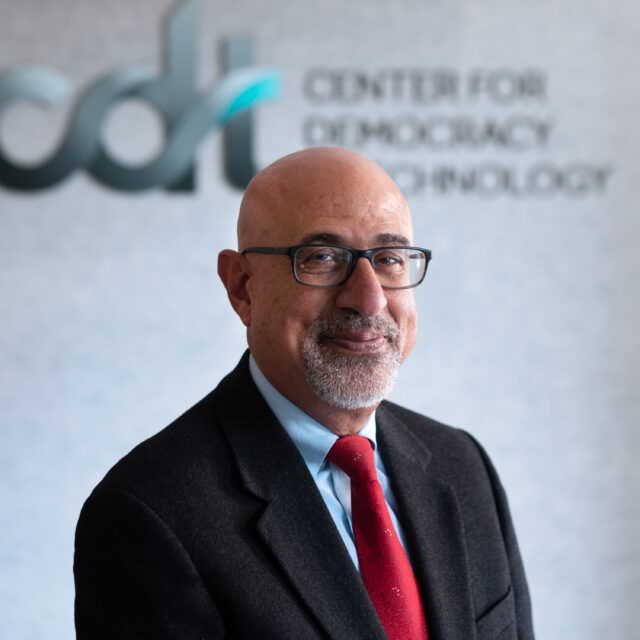
Greg Nojeim
Senior Counsel and Director of CDT's Project on Freedom, Security and Technology

Gregory T. Nojeim is a Senior Counsel at the Center for Democracy & Technology and the Director of its Project on Freedom, Security & Technology. CDT is a Washington-based non-profit organization dedicated to promoting democratic values and constitutional liberties in the digital age. In this capacity, Mr. Nojeim conducts much of CDT's work in the areas of national security, terrorism, and Fourth Amendment protections. Nojeim is also Co-Chair of the Coordinating Committee on National Security and Civil Liberties of the Individual Rights and Responsibilities Section of the American Bar Association.

Nojeim works to limit the threat to privacy posed by governmental wiretapping and monitoring of Internet communications. He was instrumental in bringing together the broad coalition of groups from across the political spectrum that worked to strip overly intrusive wiretapping proposals from the 1996 anti-terrorism law. He has substantial expertise on the application ... More »

Gregory T. Nojeim is a Senior Counsel at the Center for Democracy & Technology and the Director of its Project on Freedom, Security & Technology. CDT is a Washington-based non-profit organization dedicated to promoting democratic values and constitutional liberties in the digital age. In this capacity, Mr. Nojeim conducts much of CDT's work in the areas of national security, terrorism, and Fourth Amendment protections. Nojeim is also Co-Chair of the Coordinating Committee on National Security and Civil Liberties of the Individual Rights and Responsibilities Section of the American Bar Association.

Nojeim works to limit the threat to privacy posed by governmental wiretapping and monitoring of Internet communications. He was instrumental in bringing together the broad coalition of groups from across the political spectrum that worked to strip overly intrusive wiretapping proposals from the 1996 anti-terrorism law. He has substantial expertise on the application of the Foreign Intelligence Surveillance Act and on the civil liberties protections it affords. Other areas of his expertise include governmental data mining, the PATRIOT Act, the state secrets privilege, and the privacy implications of aviation security measures.

Prior to joining CDT in May 2007, Mr. Nojeim was for five years a Legislative Counsel at the American Civil Liberties Union and for seven years the Associate Director and Chief Legislative Counsel of the ACLU's Washington Legislative Office. There, he was responsible for analyzing the civil liberties implications of federal legislation relating to terrorism, national security, immigration and informational privacy. He frequently testified before congressional committees and the various commissions Congress establishes on anti-terrorism legislation and aviation security legislation. Nojeim testified before Congress about counter-terrorism proposals following the September 11 attacks and the Oklahoma City bombing, the use of secret evidence in immigration proceedings, driver’s license privacy, aviation security profiling and intrusive body-scan technologies and the threat to civil liberties posed by national ID cards.

Mr. Nojeim also served for four years the Director of Legal Services of the American-Arab Anti-Discrimination Committee (ADC). He conducted much of ADC's work in the immigration, civil rights, and human rights areas. Mr. Nojeim was employed for five years as an attorney with the Washington, D.C. law firm of Kirkpatrick & Lockhart (now Kirkpatrick & Lockhart Preston Gates Ellis LLP) where he specialized in mergers and acquisitions, securities law, and international trade. He was graduated Magna Cum Laude from the University of Rochester in 1981, where he studied Political Science. He received his J.D. from the University of Virginia in 1985 and sat on the Editorial Board of the Virginia Journal of International Law.
PUBLICATIONS

2010

Greg Nojeim, Cybersecurity and Freedom on the Internet, Journal of National Security Law and Policy, Volume 4, Issue 1, 2010

« Less

From the Journal of National Security Law and Policy, Volume 4, Issue 1:

Cybersecurity has become a national imperative and a government priority. Increased cybersecurity will help protect consumers and businesses, ensure the availability of critical infrastructures on which our economy depends, and strengthen national security. However, cybersecurity efforts must be carefully tailored in order to preserve privacy, liberty, innovation, and the open nature of the Internet. To design an effective and balanced cybersecurity strategy, each part of the country’s critical infrastructure3 must be considered separately. Solutions that may be appropriate for the power grid or financial networks may not be suitable for securing the public portions of the Internet that constitute the very architecture for free speech essential to our democracy. Policy toward government systems can be much more prescriptive than policy toward private systems. The characteristics that have made the Internet such a success – its openness, its decentralized and user-controlled nature, and its support for innovation and free expression – may be put at risk if heavy-handed policies are enacted...

One of the recurring arguments we hear in the debate about cybersecurity policy is that the government needs to step in to secure private networks because the private sector is not doing enough on its own.  Some say there has been a “market failure” that requires government intervention because there is an insufficient financial incentive for entities in the private sector to provide an appropriate level of security. A major reason to be skeptical about these arguments for government intervention is that the government has failed to date to secure its own systems.  And, many of the government-knows-best security solutions – like security mandates for software, government monitoring of communications across private networks, and authority in the President to shut down or limit Internet traffic to particular systems – would stifle innovation and threaten privacy.

Further evidence that the private sector is quite well-incentivized to improve security comes in the form of two recent corporate announcements.

A deeply divided  Ohio Supreme Court has ruled that cell phones contain such sensitive information that law enforcement cannot automatically examine their contents when the cell phone is seized from a person being arrested.  Instead, the court ruled 4-3 that the Fourth Amendment requires that the police first obtain a warrant based on probable cause before they look at an address book or call records on a cell phone. 

Refreshingly, the court recognized that cell phones "have the ability to transmit large amounts of data in various forms, likening them to laptop computers, which are entitled to a higher expectation of privacy." The court reasoned that cell phones' ability "to store large amounts of private data gives their users a reasonable and justifiable expectation of a higher level of privacy in the information they contain...  because a person has a high expectation of privacy in a cell phone’s contents, police must  then obtain a warrant before intruding into the phone’s contents."

The court looked forward and accounted for the way technology is evolving:  cell phones are getting smarter, and will in the future have very powerful computing power and contain more and more personal information about transactions, associations, and activities. 

Everyone agrees: cybersecurity is a big problem. Computer hackers are stealing government secrets and millions of dollars. Consumers’ computers are being taken over unbeknownst to them and are being used to spread malicious computer code. 

Everyone agrees: the status quo is untenable. Something has to be done about this problem, but there’s no silver bullet. Cybersecurity solutions will involve consumers, communications and tech companies, and the government. With so many players, education and information sharing will be part of the solution.
 
Everyone agrees, but only up to a point: When the sleeves roll up and concrete ideas are put on the table, civil liberties warning signs begin to flash and privacy alarm bells begin to ring. That’s what was happening at the Senate Judiciary Committee hearing on cybersecurity on November 17 and scroll down to “Webcast Archives” on the right], at which I testified.
 
Syndicate content
See all Greg Nojeim's Work